Find Your Path to Peace and Growth
Transform Your Life With
Attunement Coaching and Training
Based on the work of nonviolent communication and resonant healing

When was the last time you felt truly heard, or understood?
Imagine a world where every conversation builds connection, where empathy replaces judgment, and where our words create bridges, not barriers. Rooted in the transformative work of Dr. Marshall Rosenberg, Nonviolent Communication (NVC) is a language of compassion that empowers us to speak and listen from the heart—fostering deeper understanding, authentic relationships, and peaceful resolution in every part of life.
Below you’ll find resources for organizations, individuals and families looking to start the journey of growth through Nonviolent Communication.
NVC in Organizations
Are you wishing your organization could communicate in a way that maximizes performance while fostering connection?
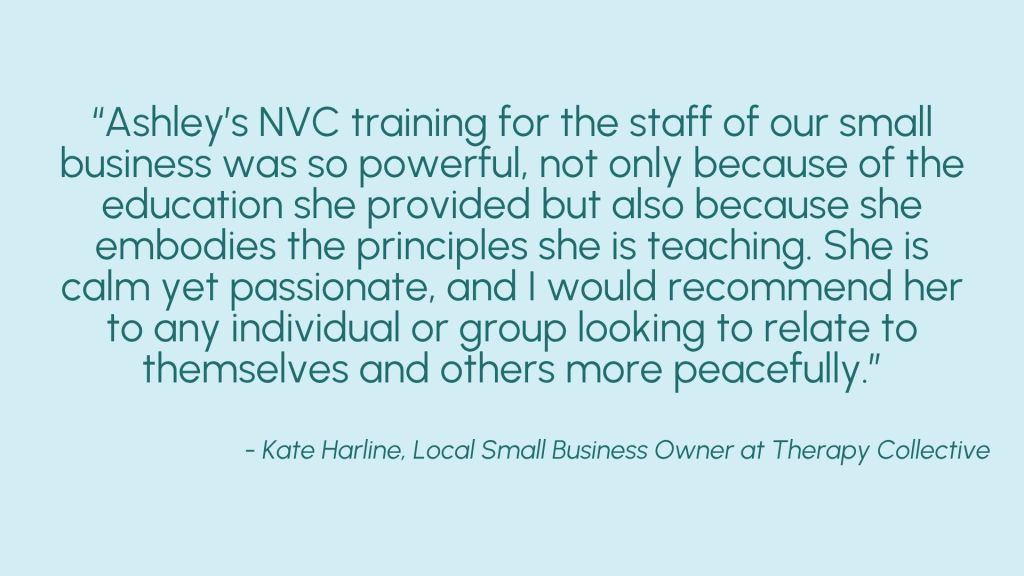
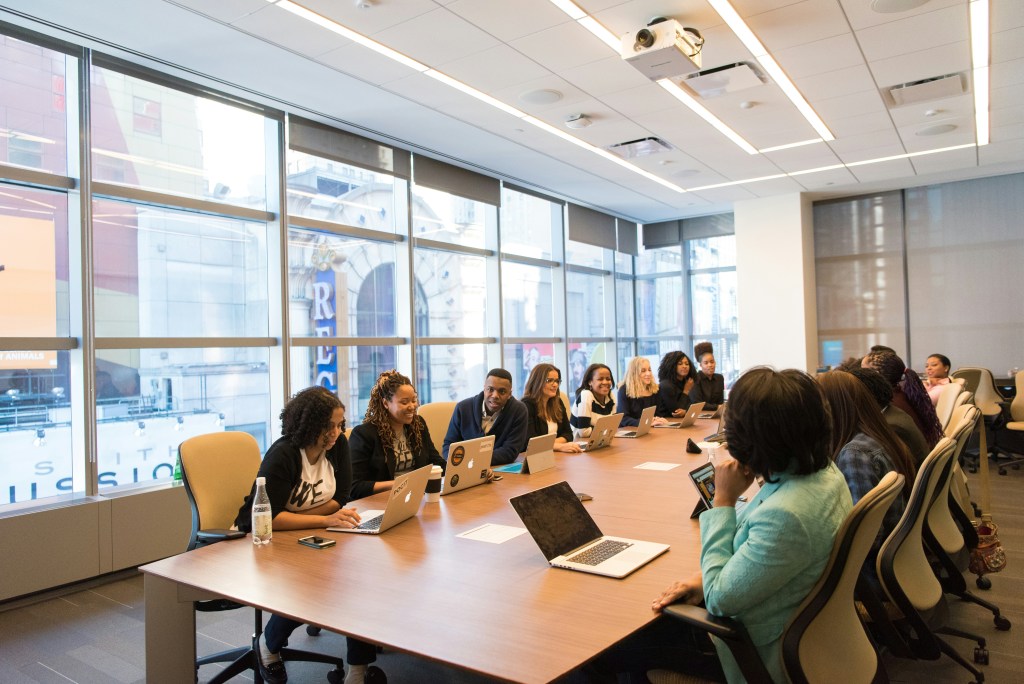
Nonviolent Communication has been shown to significantly enhance workplace collaboration, employee engagement, and conflict resolution. Research indicates that organizations integrating NVC principles experience improved team dynamics, reduced employee turnover, and more constructive feedback cultures. By fostering empathy, clarity, and mutual respect, NVC equips organizations to navigate difficult conversations, build emotional safety, and drive more resilient, people-centered performance.
Click here to learn more about how NVC can help your organization

NVC for Individuals
Have you ever felt like meaningful deep relationships are out of reach or that you struggle with something painful from your past?
Nonviolent Communication (NVC) can help heal past hurt by creating a safe, compassionate space to explore and express painful emotions without judgment or blame. It helps individuals connect with their unmet needs behind those hurts—like the need for safety, love, or understanding—and gives language to experiences that may have felt overwhelming or confusing. Through empathetic listening, either from others or within oneself, NVC fosters validation, clarity, and emotional release, allowing old wounds to be seen, understood, and gradually transformed. FMRI studies show that new neural connections are made that allow for healing and new understanding when NVC is practiced over time.
NVC in the Family
Are you looking for a better way to communicate and connect with your family, especially during conflict or stress?
Nonviolent Communication (NVC) brings hope and compassion to your closest relationships by helping you express yourself honestly, listen with empathy, and ensure that everyone’s needs are heard and met. It creates a foundation of trust, eases conflict, and fosters deeper, more loving connections, lighting the path of healing, growth, and mutual fulfillment. NVC is helping couples and families with children foster deep vibrant connections.


Attunement Communication Groups
Attunement Communication groups combine Marshall Rosenberg’s Nonviolent Communication with Sarah Peyton’s Resonance work to create a space of vulnerability, warmth, and curiosity. In these groups, participants explore honesty, bravery, and presence while engaging with real interpersonal challenges. Backed by research showing that collaborative learning is one of the most effective ways to develop and apply new skills, these practice groups support deep learning through social interaction and peer feedback. Over time, this repeated engagement helps form new neural pathways, creating lasting change. Guided by a skilled facilitator, each group includes 10–12 committed individuals dedicated to growing together in a safe, supportive environment.

Meet Ashley
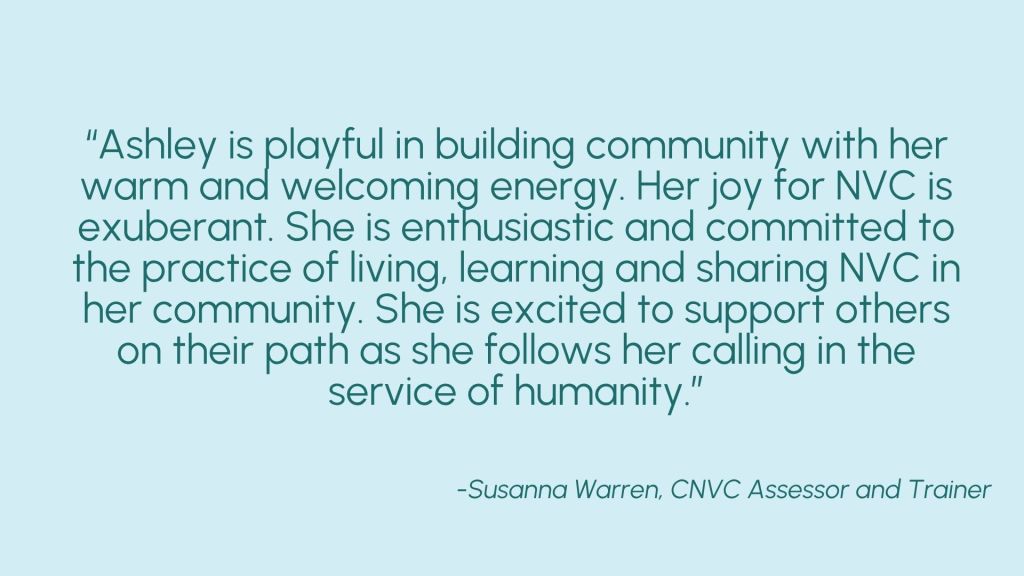
Trained by NVC experts throughout the world, Ashley is the first Training Candidate with the International Center for Nonviolent Communication (CNVC) to live and teach in Utah. With an impressive academic background, she holds a Master of Public Administration and a Bachelor of Social Work from the University of Utah. Ashley has made a significant impact in her community by introducing Circles, a national anti-poverty initiative based on Bridges out of Poverty, to Salt Lake City, and by developing innovative children’s programming for homeless shelters across the state. Her dedication to social change and her expertise in NVC make her a transformative leader in the field.
A Message from Ashley:
I grew up with divorced parents who were as different as night and day. I loved each of them a lot but it was hard to feel happy when they were so unhappy. Part of their unhappiness was the belief by each of them that the other parent was wrong or bad. Because I was like both of them this left me feeling that parts of me were wrong or bad. Whether it was religion, food, hobbies or pets, I didn’t know what I really liked, only what I needed to act like when I was around one of them. As a result, I became a people pleaser and found that the only time I liked myself was when I was trying to make someone else happy. Later in life I chose a career working with people whose lives were chaotic, trying to save them, not realizing that I was avoiding the chaos inside myself. I could pat myself on the back for doing a good job helping others, but I was ignoring myself and the needs I had shelved. Then a friend introduced me to the book, Nonviolent Communication, by Marshall Rosenberg, and something clicked. This is what I had been missing in my hectic lifelong search for answers. I read and re-read the book, made the rash decision to go to India to be trained by certified NVC trainers, and recognized that my unmet needs in life had led me to the gift of becoming a certified trainer to bring the peace and understanding that NVC offers to others. I am a different person with NVC. I wake up with peace and enjoy the experience of being me. I know what I like and what makes me happy. I know how to meet my needs.
NVC teaches that there are no bad needs, only unhelpful strategies to try to meet them. Once I began identifying my needs, I found ways to meet them, making my life and the lives of those around me more fulfilling. The positive impact of NVC in my life has filled me with desire to share it with my community.